ELIZA64
A downloadable game
EEEEEE  LL      IIII  ZZZZZZ   AAAAA
EE      LL       II      ZZ   AA   AA
EEEEE   LL       II     ZZ    AAAAAAA
EE      LL       II    ZZ     AA   AA
EEEEEE  LLLLLL  IIII  ZZZZZZ  AA   AA
Everybody name-drops ELIZA when they talk about AI. Almost nobody has actually talked to "her". Here she is: the first chatbot, 1966, rebuilt in 6502 assembly so a 1 MHz Commodore 64 answers the instant you hit RETURN — and because we'd rather see if we could, then spend time worrying about if we should... We packaged ELIZA with AURA, who runs the exact same sixty-year-old machinery and uses it to ask whether you're being fr or just kind of sus. AURA is a nod to the confused Gen-X father who needs a shot at navigating the slang his Gen-Z children slip his way. A beige breadbox that says deadass. ELIZA's Doctor talks like a therapist in a tweed jacket, AURA is engaged in pure brainrot, and neither of them understands a single word you say — which is the whole trick, and you can watch it happen from the inside. Type something true into either one and see what a machine older than you hands back. Then open the authoring kit in your browser, fill in the blanks, and press a disk with a voice of your own on it. Fifteen minutes, no programming, and something you scripted is talking back to you off a floppy.
The Backstory
In 1966 Joseph Weizenbaum published a program that appeared to listen. ELIZA, running the DOCTOR script at MIT's Project MAC, held a conversation convincing enough that people confided in it, argued with it, and asked to be left alone with it. Weizenbaum spent much of the rest of his life explaining that it did not understand a word.
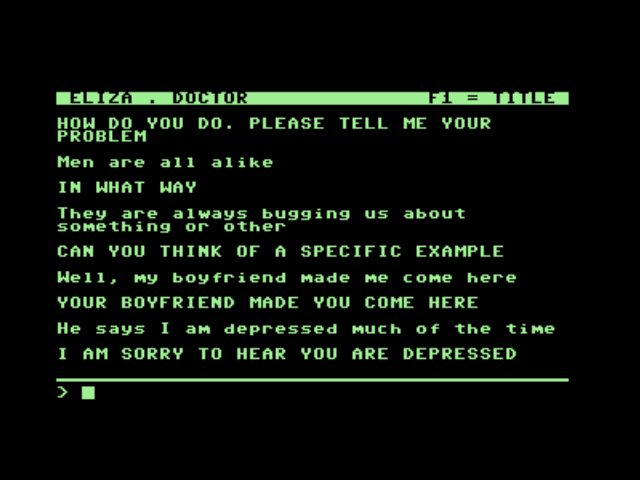
This is that program. Not a tribute, not a simplification, not the BASIC listing from a 1970s magazine. The complete 1966 mechanism, written in 6502 assembly, running on a stock Commodore 64.
The real engine
Nearly every ELIZA you have met on a home computer descends from the same short BASIC sketch: find one keyword, flip the pronouns, print a canned line. That program is a cousin of ELIZA, not a copy of it. It throws away most of what Weizenbaum actually built.
ELIZA 64 implements the original mechanism in full:
- Ranked keywords with a real keyword stack
- Decomposition patterns with numbered capture pieces and word classes
- Reassembly templates that cycle, so the DOCTOR does not repeat herself
- Substitution and conjugation during the scan
- Keyword linking (
=WHAT,=YOU) and PRE rewrites, where the sentence is rebuilt and re-entered under a different keyword - NEWKEY — abandon this keyword, try the next one down the stack
- MEMORY, the four-template mechanism that lets the DOCTOR return, several exchanges later, to something you mentioned in passing
- The NONE fallback pool
The published DOCTOR script is the one from the 1966 CACM paper, and the engine's logic follows the 1965 MAD-SLIP source recovered from the MIT archives in 2021. Both are treated as primary sources, not inspiration.
We made one deliberate departure. Weizenbaum's paper describes a keyword stack, and the published DOCTOR script is written assuming one — REMEMBER, DREAMT, WAS and LIKE all end with a NEWKEY instruction meaning "this matched, but let somebody else answer." The recovered source shows the stack was never actually built: those rules led nowhere. ELIZA 64 builds the stack the paper describes, which makes this DOCTOR marginally more complete than the one that ran in 1966. It is the only place where the paper and the code disagree, and it is called out in the documentation.
It is fast because it is assembly
The BASIC ELIZAs of the 1980s paused, chugged, and thought visibly about every line. This one answers as fast as a 1 MHz 6502 can walk a table, which is instantly. Every reply arrives complete; the typewriter reveal you see is a presentation choice, tunable by one constant, not the machine struggling.
The script is data, loaded from disk into a 24K window. The engine never changes when the personality does. That was Weizenbaum's architecture, and it is the whole point.
Every reply has been proven reachable
A fair question about any ELIZA: are all those responses actually possible, or does the conversation just circle the same handful?
We answered it with an instrument and tasked claude.ai to produce a coverage analyzer, that walks each script, synthesizes an input for every decomposition pattern, works each one backwards through the substitution table, waits out higher-ranked keywords that would hijack the turn, and confirms which reply slot actually fired. The verdict for the 1966 DOCTOR: 211 reassembly slots, 211 reached. No dead replies. Nothing unreachable.
One slot in the 1966 script can be reached only through the subjunctive — you have to type "i were wrong," which puts the word WAS into the sentence without you ever typing it. It has been sitting there since 1966. It works.
Two voices, and a kit for writing your own
DOCTOR (1966) is the Rogerian therapist Weizenbaum published, in teletype green, with no punctuation, exactly as the script was written.
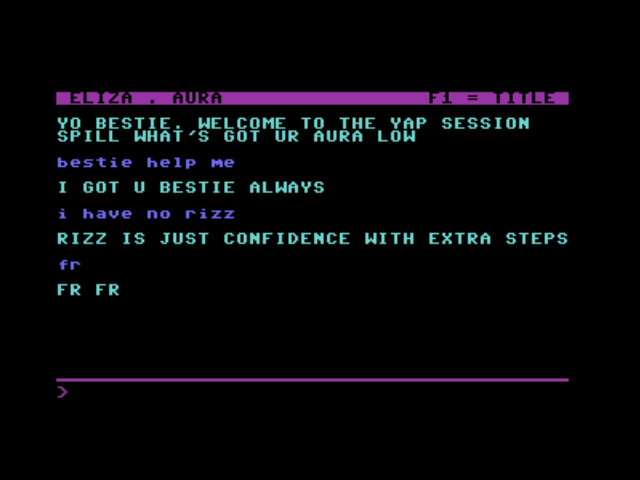
AURA (2026) is the same script flipped: identical skeleton, identical keyword ranks, identical pattern wiring, every reply rewritten in Gen Z slang, with a dialect layer that hears u, ur, fr, sus, deadass, cringe, brainrot. She arrives in purple and cyan with her own sound. She required zero engine changes to ELIZA in order to exist, personality is the data.
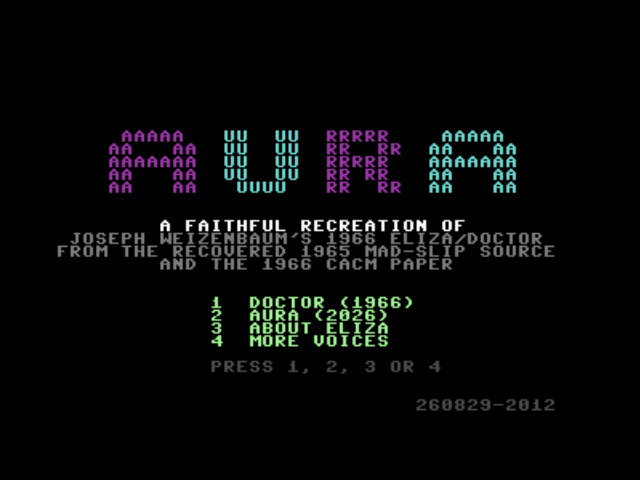
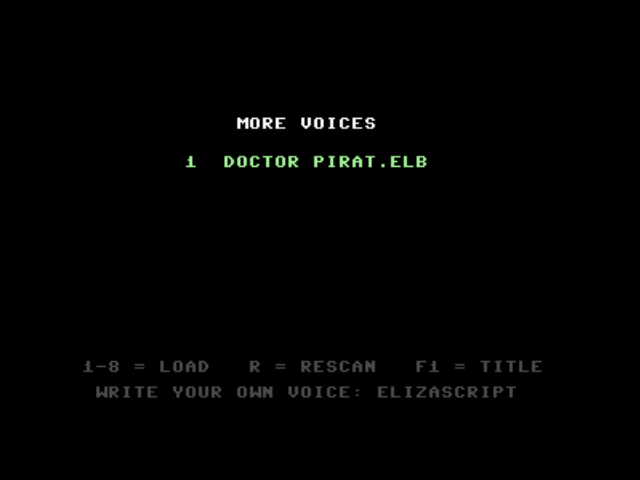
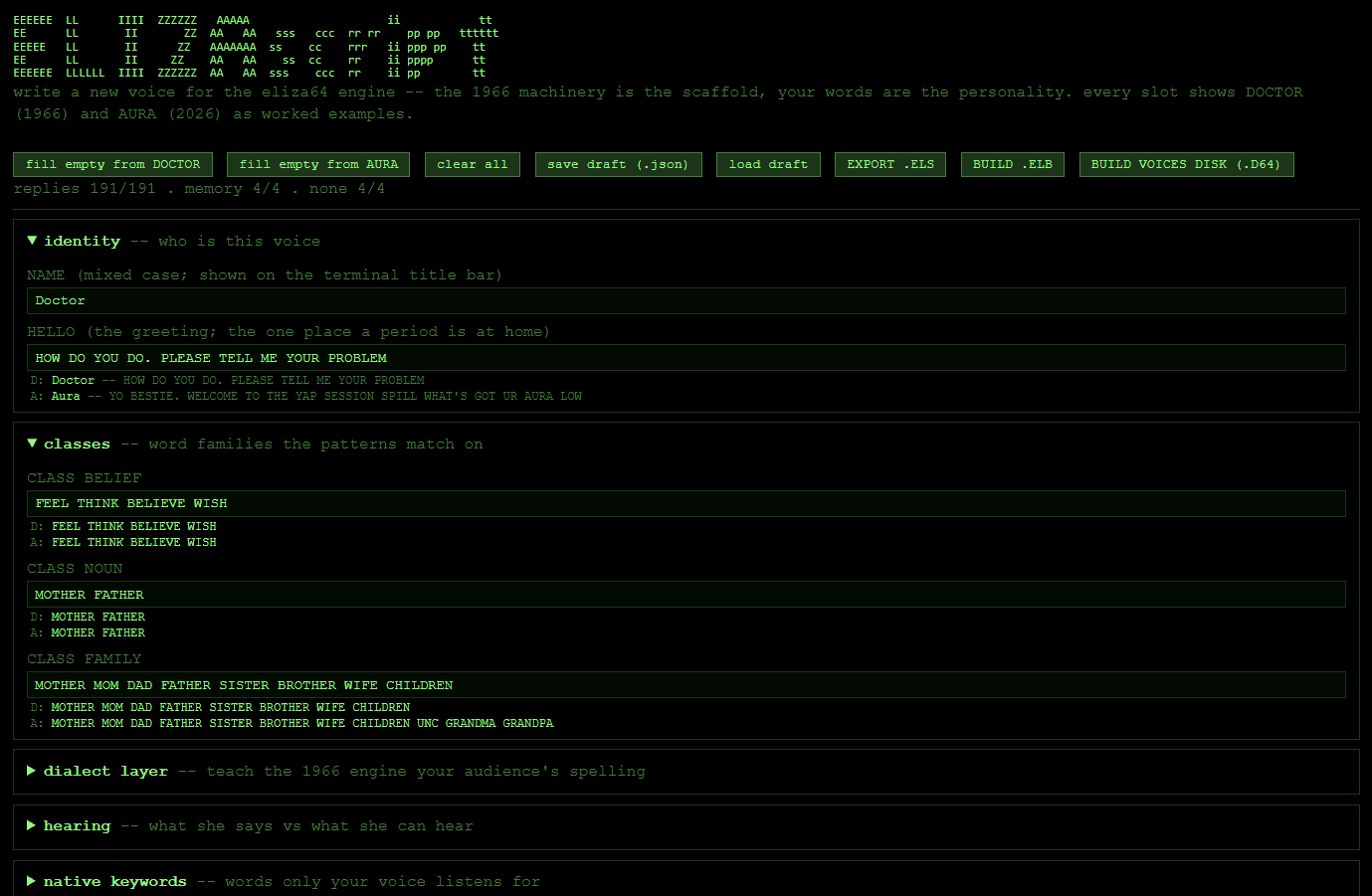
ELIZAscript.html is a browser authoring tool that ships with the game. The html based tool presents the 1966 skeleton, every keyword, rank, pattern, and structural slot. To generate a new voice, to load into Eliza, you simply fill in the replies. We've provided both the DOCTOR original and the AURA flip shown beside every blank as worked examples. The scripting tool includes a live "hearing" lint, that warns you when your new voice uses words, that the script cannot actually hear, and offers to teach them to the tool. Press one button and it compiles your script and presses a real 1541 disk image in the browser. Mount it, choose MORE VOICES on the title screen, and talk to something you wrote. No toolchain, no assembler, no command line.
What's in the "box"
eliza64.d64— the disk image: DOCTOR, AURA, splash, ABOUT, and the MORE VOICES browsereliza64.crt— an EasyFlash cartridge for instant boot with no diskelizascript.html— the authoring tool, one self-contained file, runs offline in any modern browser- Runs on a stock C64, VICE, and the C64 Ultimate
Credit
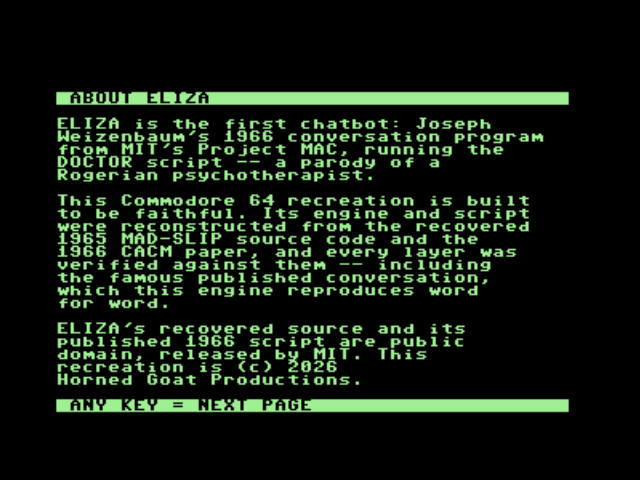
ELIZA was created by Joseph Weizenbaum at MIT, 1964–1966. The recovered source and the published script are public domain, released by MIT. This recreation is © 2026 Horned Goat Productions.
Download
Install instructions
LOAD"*",8,1
RUN
(note: .d64 version expects drive to be device 8)
Development log
- ELIZA648 days ago

Comments
Log in with itch.io to leave a comment.
very good
Thanks for the feedback Marco - It's been a lot of fun!